
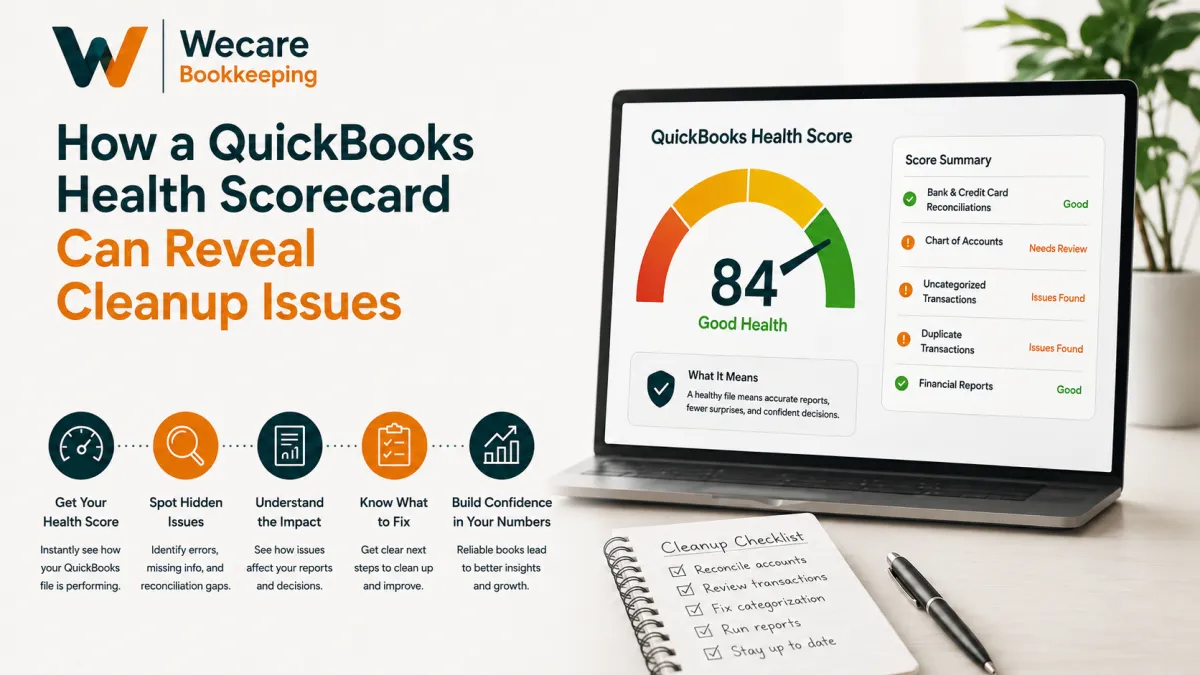
How a QuickBooks Health Scorecard Can Reveal Cleanup Issues
The Importance of Checking Your QuickBooks Health
A connected bank feed does not confirm that a QuickBooks file is accurate. Transactions can still be duplicated, misclassified, unreconciled, recorded in the wrong period, or posted to incorrect Balance Sheet accounts.
A QuickBooks Health Scorecard provides a structured way to review the condition of the file. It can help identify reconciliation gaps, unclear balances, uncategorized activity, reporting concerns, and workflow weaknesses before monthly bookkeeping or cleanup work begins.
The scorecard is not a substitute for a detailed review of the underlying records. It is an initial diagnostic tool that helps determine which areas may require further investigation.
Spotting Reconciliation Gaps
Reconciliation confirms that the transactions and ending balance in QuickBooks agree with the supporting bank, credit card, loan, or processor statement for a specific period.
A health review should identify:
The last completed reconciliation date for each active account
Accounts that have never been reconciled
Reconciliation differences or unexplained adjustments
Old outstanding checks or deposits
Duplicate transactions
Missing transactions
Beginning balances that do not agree with prior records
An account may appear close to the bank balance while still containing historical errors. The reconciliation history and supporting statements should be reviewed together.
Reviewing Bank-Feed Activity
Bank feeds can reduce manual entry, but they may also create problems when transactions are added without checking whether they already exist.
A scorecard review may flag:
Deposits recorded as income when they should have been matched to invoice payments
Credit card payments recorded as expenses
Transfers recorded as income or expenses
Loan payments recorded entirely as interest
Duplicate transactions created by manual entries and bank feeds
Broad bank rules that assign unrelated activity to the same category
Bank-feed activity should be reviewed as part of the monthly reconciliation process rather than accepted automatically.
Identifying Reporting Concerns
A QuickBooks file should produce reports that are understandable and reasonably consistent with the business’s actual activity.
A health review may identify:
A chart of accounts with too many duplicate or inactive accounts
Large balances in uncategorized income, uncategorized expenses, suspense, or Ask My Accountant
Negative balances that do not make sense
Revenue or expenses assigned inconsistently
Personal transactions mixed with business activity
Loan, payroll, sales-tax, or credit-card balances that appear incomplete
Reports that change significantly after the books were believed to be closed
These issues do not always mean the entire file requires cleanup. They indicate where the underlying transactions and account structure should be reviewed.
Checking Balance Sheet Accounts
The Balance Sheet often reveals problems that are less visible on the Profit and Loss statement.
A health scorecard should review:
Bank and credit card balances
Accounts receivable
Accounts payable
Loans and other liabilities
Sales-tax and payroll liabilities
Inventory
Payment-processor clearing accounts
Owner contributions, draws, and equity accounts
Opening Balance Equity
Old, negative, or unexplained balances may indicate missing transactions, incorrect classifications, duplicate entries, or incomplete historical work.
Balance Sheet accounts should be supported by statements, schedules, aging reports, or other records where applicable.
Reviewing Uncategorized and Suspense Activity
Uncategorized and suspense accounts are useful temporarily when a transaction cannot be identified immediately. They should not become permanent storage areas.
A scorecard review should consider:
The total balance in each suspense or uncategorized account
The age of the transactions
Whether the same vendors appear repeatedly
Whether transactions are missing supporting documentation
Whether prior-period items remain unresolved
A large or growing balance may indicate that the monthly review process is incomplete or that transaction questions are not being resolved consistently.
Reviewing Accounts Receivable and Accounts Payable
Accounts receivable and accounts payable should agree with the underlying customer and vendor activity.
A health review may identify:
Old unpaid customer invoices
Customer payments that were recorded but not applied
Duplicate invoices or bills
Vendor credits that were not applied
Negative customer or vendor balances
Bills or invoices that no longer represent valid obligations
Deposits recorded directly to income while invoices remain open
Aging reports should be reviewed with the business owner because some old balances may be legitimate, while others may require correction.
What a QuickBooks Health Scorecard May Review
A practical scorecard may evaluate several areas:
Reconciliation status
Bank-feed accuracy
Chart-of-accounts structure
Uncategorized activity
Accounts receivable
Accounts payable
Loan and credit-card balances
Payroll and sales-tax liabilities
Clearing accounts
Reporting consistency
Closing-date controls
Supporting documentation and monthly workflows
The score should be treated as a screening result rather than a final accounting conclusion. A lower score indicates that more areas require review, but it does not determine the exact cleanup scope by itself.
What the Scorecard Cannot Confirm
A scorecard cannot confirm that every transaction has been recorded correctly or that the financial statements comply with all accounting, tax, or reporting requirements.
It may not detect:
Missing activity that never entered QuickBooks
Incorrect supporting documents
Revenue-recognition issues
Inventory quantities or valuation errors
Tax filing obligations
Contract-specific accounting requirements
Fraud or intentional misstatement
Questions involving tax returns, formal financial statements, audits, legal obligations, or specialized accounting treatment should be reviewed by the appropriate qualified professional.
When to Consider Professional Cleanup
Professional cleanup may be appropriate when the review identifies multiple unresolved issues, historical reconciliation gaps, unreliable Balance Sheet balances, duplicate transactions, inconsistent categories, or reports that cannot be explained from the available records.
A cleanup review may include:
Confirming the last reliable bookkeeping period
Reconciling historical accounts
Correcting duplicate or missing transactions
Reviewing opening balances
Resolving uncategorized activity
Correcting account classifications
Reviewing receivables, payables, loans, and liabilities
Reorganizing the chart of accounts where needed
Cleanup and catch-up bookkeeping are different services. Cleanup corrects unreliable existing records, while catch-up bookkeeping completes missing periods.
When Monthly Bookkeeping May Be the Better Next Step
A file may not require a major cleanup when the core balances are reliable and the main issue is maintaining a consistent monthly process.
Structured monthly bookkeeping may be the appropriate next step when:
Accounts are current and reasonably reconciled
Historical balances are supported
Only a small number of classification questions remain
The chart of accounts is usable
The business needs consistent transaction review and reporting
The diagnostic review should determine whether the next step is cleanup, catch-up work, monthly bookkeeping, or a combination of services.
Take the First Step
A QuickBooks Health Scorecard can provide a useful starting point for understanding the current condition of the file. The results can help identify which accounts, reports, and workflows need closer review.
The most useful next step depends on what the scorecard reveals. Some files need targeted corrections, while others require historical cleanup, catch-up bookkeeping, or a more consistent monthly process.
Use the QuickBooks Health Scorecard, learn more about my QuickBooks Services, or schedule a free consultation to discuss the condition of your QuickBooks file.
Frequently Asked Questions
What is a QuickBooks Health Scorecard?
It is a structured review that evaluates areas such as reconciliations, account balances, uncategorized activity, reporting consistency, and bookkeeping workflows.
Does a good score guarantee that the books are accurate?
No. A scorecard is a screening tool. It can identify warning signs, but a detailed review of transactions, balances, and supporting records may still be required.
What are common signs that QuickBooks needs cleanup?
Common signs include unreconciled accounts, duplicate transactions, unexplained balances, large suspense-account balances, unreliable reports, and inconsistent transaction categories.
Is QuickBooks cleanup the same as catch-up bookkeeping?
No. Cleanup corrects records that were entered incorrectly. Catch-up bookkeeping records missing activity for periods that were not completed.
What happens after the health review?
The next step may be targeted corrections, QuickBooks cleanup, catch-up bookkeeping, or structured monthly bookkeeping, depending on the condition of the file.