
How Much Does QuickBooks Cleanup Cost?
When a QuickBooks Online file contains unreconciled accounts, duplicate transactions, incorrect balances, or years of inconsistent categorization, the first question is often straightforward: how much will it cost to clean up?
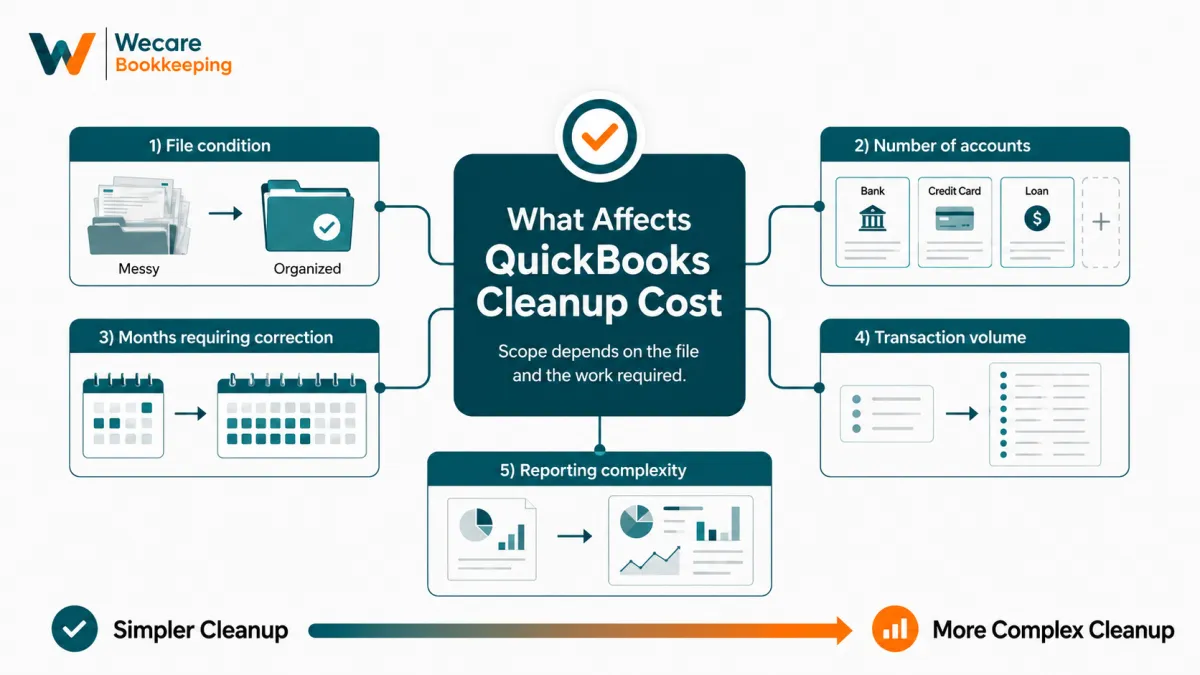
The honest answer is that QuickBooks cleanup cost depends on the condition and complexity of the file. Two businesses may each need twelve months reviewed, but the amount of work can be very different. One file may have complete statements, a small number of accounts, and a limited set of errors. Another may include multiple payment processors, missing records, duplicated revenue, unreconciled loans, and balances that cannot be supported.
That is why a responsible cleanup estimate usually begins with a review. The purpose is not simply to count months. It is to determine what needs to be corrected, what documentation is available, and what the finished records need to support.
What Is a QuickBooks Cleanup?
A QuickBooks cleanup is a project to correct inaccurate, inconsistent, duplicated, unreconciled, or structurally problematic bookkeeping records.
Depending on the file, cleanup work may involve:
Reviewing and correcting transaction classifications
Reconciling bank and credit-card accounts
Investigating unsupported balances
Removing or correcting duplicate activity
Reviewing opening balances
Correcting transfers between accounts
Organizing the chart of accounts
Reviewing accounts receivable and accounts payable
Correcting payment-processor activity
Resolving old uncategorized or suspense-account balances
Improving the reporting structure for future bookkeeping
Cleanup is different from catch-up bookkeeping, which generally means entering or completing activity that was never recorded. Some businesses need cleanup, some need catch-up work, and some need both.
Cleanup is also different from recurring monthly bookkeeping services. Cleanup establishes a reliable starting point. Monthly bookkeeping maintains the records after that starting point has been created.
A cleanup engagement does not automatically include tax preparation, audit work, legal advice, or every historical accounting determination. The exact scope should be defined before work begins.
Why QuickBooks Cleanup Prices Vary
The central pricing principle is simple:
Cleanup pricing should follow the condition and complexity of the records, not only the number of months involved.
A file with six months of activity can require more work than a file with eighteen months of activity. The amount of time depends on how many transactions and accounts must be reviewed, how reliable the existing records are, and how much supporting documentation is available.
A reliable estimate should answer three questions:
What is wrong or incomplete?
What work is required to correct it?
What result is the client expecting when the project is finished?
Without those answers, a price may be little more than a guess.
The Main Factors That Affect QuickBooks Cleanup Cost
Number of Months or Years Requiring Review
The historical period matters because each month may contain transactions, statements, reconciliations, journal entries, and account balances that require review.
However, the number of months is only a starting point. Twelve clean, low-volume months may be easier to correct than three disorganized months with several systems feeding data into QuickBooks.
The review should identify whether every period requires detailed work or whether the problem is concentrated in specific months.
Transaction Volume
Transaction volume directly affects the amount of activity that may need to be examined.
This can include:
Bank transactions
Credit-card transactions
Loan payments
Customer payments
Vendor payments
Payroll entries
Payment-processor transactions
Transfers
Owner contributions or withdrawals
Manual journal entries
High volume does not automatically mean every transaction requires individual correction. A well-structured file with consistent rules may still be manageable.
The cost increases when high volume is combined with inconsistent categorization, duplicated entries, missing support, or unreliable reconciliations.
Number of Financial Accounts
Each active financial account adds another set of balances and transactions to review.
Common accounts include:
Operating bank accounts
Savings accounts
Credit cards
Lines of credit
Loans
PayPal, Stripe, Square, or other processors
Ecommerce clearing accounts
Payroll clearing accounts
A business with one bank account and one credit card generally has a narrower cleanup scope than a business with several accounts, multiple processors, and transfers moving between them.
Closed accounts may also require review if old balances remain in QuickBooks or if the closing transactions were recorded incorrectly.
Reconciliation Condition
Reconciliation problems are one of the most important cleanup-cost drivers.
The review may reveal:
Accounts that were never reconciled
Reconciliations that stopped several months ago
Incorrect beginning balances
Deleted or altered reconciled transactions
Duplicate transactions added after reconciliation
Statement balances that do not match QuickBooks
Old reconciliation adjustments that were never explained
A missing reconciliation does not always mean the entire period must be rebuilt. The amount of work depends on whether statements are available and whether the underlying transactions are complete.
Duplicate or Missing Activity
Duplicate activity often occurs when bank-feed transactions are added on top of manually entered sales, invoices, deposits, or processor summaries.
Common examples include:
Customer payments recorded as income again when deposited
Shopify or Stripe sales entered individually and then duplicated through bank feeds
Transfers categorized as income or expenses
Credit-card payments entered as new expenses
Payroll withdrawals recorded without the corresponding payroll detail
Missing activity creates a different problem. Statements may show transactions that never reached QuickBooks, or an integration may have stopped importing information.
Both situations require investigation before correction. The cost depends on how widespread the issue is and whether the original source records are available.
Chart of Accounts Problems
The chart of accounts controls how transactions appear on financial reports.
Cleanup may be more involved when the file contains:
Too many nearly identical accounts
Personal and business activity mixed together
Income recorded in expense accounts
Loan payments recorded entirely as expenses
Assets or liabilities recorded as ordinary income or expenses
Old accounts that remain active without a purpose
Broad categories that hide useful detail
Excessive detail that makes reports difficult to read
The objective is not to create the longest possible chart of accounts. It is to create a structure that fits the business and supports understandable reporting.
Some account treatments may depend on the business’s circumstances and guidance from its outside accountant or tax professional.
Accounts Receivable and Accounts Payable
A cleanup becomes more complex when customer and vendor balances do not agree with supporting records.
Accounts receivable issues may include:
Old invoices that were already paid
Payments not applied to invoices
Customer credits that remain unresolved
Duplicate invoices
Negative customer balances
Deposits recorded without identifying the customer activity
Accounts payable issues may include:
Old bills that were already paid
Duplicate bills
Vendor credits not applied
Payments entered without matching bills
Unsupported negative vendor balances
The goal is not merely to remove old items. Each balance should be reviewed so that legitimate open activity is not deleted along with incorrect activity.
Payroll and Payment-Processor Activity
Payroll and payment processors often create gross-versus-net recording problems.
A bank deposit from a processor may represent:
Gross sales
Less refunds
Less processor fees
Less chargebacks
Plus or minus timing differences
Recording only the net deposit can understate revenue and expenses.
Payroll withdrawals may also combine wages, employer costs, employee withholdings, and tax payments. Cleanup work may require payroll reports or summaries to support the entries.
The bookkeeping cleanup should remain within the agreed scope. Payroll tax filings, tax corrections, and specialized accounting conclusions may require the appropriate payroll provider or outside professional.
Inventory, Loans, Fixed Assets, and Other Balance-Sheet Accounts
Balance-sheet accounts often require more investigation than ordinary expense categories because the balance carries forward from one period to the next.
Examples include:
Inventory
Loans and lines of credit
Fixed assets
Accumulated depreciation
Security deposits
Customer deposits
Sales-tax liabilities
Payroll liabilities
Owner equity
Due-to-owner or due-from-owner balances
A cleanup may organize and reconcile the underlying records, but the appropriate tax or accounting treatment may require guidance from the business’s accountant or tax professional.
Quality of Available Documentation
Complete documentation can reduce uncertainty and unnecessary investigation.
Useful records may include:
Bank and credit-card statements
Loan statements
Payment-processor reports
Payroll reports
Accounts receivable details
Accounts payable details
Prior financial statements
Prior-year tax returns when relevant to beginning balances
Explanations of unusual transactions
Missing documents do not always prevent a cleanup, but they can limit what can be verified. The engagement should state what assumptions will be used and which unresolved items may remain pending.
Reporting and Deadline Requirements
The intended outcome also affects scope.
A business may need cleaned records for:
Ongoing monthly bookkeeping
An outside tax professional
A lender request
An internal management review
A funding or investor discussion
A business transition
A compressed deadline may require additional coordination or a narrower initial scope. It is important to define which periods and reports must be completed first rather than assuming every historical issue can be corrected at once.
Why a Per-Month Cleanup Price Can Be Misleading
Per-month pricing sounds simple, but it can hide the real workload.
Consider two examples.
Example 1: Twelve Months With Limited Issues
A business has:
One bank account
One credit card
Complete statements
Low transaction volume
No payroll
No payment processors
Reconciliations completed through most of the year
A small number of categorization errors
Although twelve months require review, the cleanup may be relatively contained.
Example 2: Six Months With Significant Complexity
Another business has:
Three bank accounts
Four credit cards
Stripe and PayPal
Payroll
Unreconciled loans
Duplicate revenue
Missing statements
Old accounts receivable balances
Transfers recorded as expenses
Several unexplained journal entries
This file covers only six months, but it may require substantially more work.
The shorter historical period does not make it the less expensive project. Scope and condition matter more than the calendar alone.
How a QuickBooks Cleanup Estimate Is Usually Prepared
A structured review helps turn an uncertain file into a defined project.
1. Clarify the Period and Expected Outcome
First determine which months or years require attention and what the client needs at the end.
For example, does the client need:
Corrected current-year records
A complete historical cleanup
Reliable balances before monthly bookkeeping begins
Specific reports for an outside professional
Resolution of a limited set of accounts
This prevents the project from expanding without clear priorities.
2. Review the Balance Sheet and Profit and Loss Statement
The Balance Sheet can reveal unsupported, negative, duplicated, or stale balances.
The Profit and Loss statement can reveal unusual classifications, inconsistent income recording, missing expenses, or large changes that require investigation.
These reports do not prove that the books are correct. They help identify where to look next.
3. Inspect Reconciliation History
Review which accounts have been reconciled and through what dates.
Look for:
Missing periods
Beginning-balance differences
Reconciliation adjustments
Changes to previously reconciled transactions
Statement balances that do not agree
This step often determines whether the project involves limited corrections or a deeper reconstruction.
4. Count Accounts and Transaction Sources
Identify all financial accounts and systems feeding activity into QuickBooks.
This includes bank accounts, credit cards, loans, payroll, ecommerce platforms, payment processors, expense applications, and invoicing systems.
The review should also identify inactive or closed accounts that still carry balances.
5. Identify Duplicate, Missing, or Unsupported Activity
Look for patterns rather than assuming every issue is isolated.
Examples include duplicated deposits, uncategorized transactions, transfers recorded incorrectly, old clearing-account balances, or manual entries without support.
6. Review Receivables, Payables, Payroll, Loans, and Processors
These areas often require source reports outside QuickBooks.
The reviewer should determine which records exist, which balances can be supported, and which questions must be answered by the client or an outside professional.
7. Define What Is Included and Excluded
A cleanup estimate should state the boundaries of the engagement.
For example:
Periods covered
Accounts covered
Expected corrections
Reports to be delivered
Client documentation required
Items requiring outside guidance
Work that is specifically excluded
8. Prepare a Fixed Project Estimate or Clearly Bounded Scope
Once the condition of the file is understood, the cleanup can often be priced as a defined project.
A fixed fee can give the client clarity, but it should be based on stated assumptions. If major undisclosed issues are found later, the scope-change process should be clear.
What Should Be Included in a Cleanup Proposal?
A cleanup proposal should be easy to understand.
It should normally identify:
The cleanup period
The accounts and systems included
The primary issues expected to be corrected
The planned deliverables
The client’s responsibilities
Required documentation
Important assumptions
Excluded services
The estimated timeline
Payment terms
How newly discovered issues will be handled
Cleanup and recurring monthly bookkeeping should be listed separately. This helps the client understand the difference between correcting the historical file and maintaining it going forward.
The formal engagement documentation should also define responsibilities, limitations, and payment terms before work begins.
What Can Increase the Cost After Work Begins?
A well-prepared estimate reduces surprises, but some problems are not visible during the initial review.
The cost may change if the project later includes:
Additional bank or credit-card accounts
More historical periods than originally disclosed
New payment processors or integrations
Missing statements that require reconstruction
Material discrepancies in receivables or payables
Unsupported loan or equity balances
Historical transactions changed after the review
Work requested outside the original agreement
A scope change should be explained before additional work is completed. The client should understand what was discovered, why it matters, and how it affects the fee or timeline.
Cleanup Cost Versus the Cost of Leaving the File Unresolved
The decision to clean up QuickBooks should not be based on fear. It should be based on whether the current records are useful and supportable.
Leaving significant problems unresolved can mean:
Reports remain difficult to trust
Monthly bookkeeping begins on an unstable foundation
Reconciliation differences continue into future periods
Duplicate or missing activity distorts results
More time is spent explaining reports
Outside professionals receive unclear records
Business decisions rely on incomplete information
Cleanup does not guarantee a particular financial result. Its value is in creating more organized records and a clearer basis for ongoing bookkeeping and reporting.
How to Reduce the Cost and Friction of a Cleanup
A business owner can make the cleanup process more efficient by preparing complete information.
Before work begins:
Gather all bank and credit-card statements
Identify every financial account and payment processor
Provide payroll and processor reports
Collect loan statements and supporting schedules
Explain unusual or personal transactions
Identify closed accounts that still appear in QuickBooks
Avoid making uncoordinated historical changes
Respond promptly to clarification requests
Define the required outcome and deadline
Share prior reports or records that may support beginning balances
The goal is not to organize everything perfectly before asking for help. It is to provide enough information for the cleanup professional to understand the file and resolve questions efficiently.
Establish a Clean Starting Point Before Monthly Bookkeeping
QuickBooks cleanup is not simply an exercise in making the file look neater.
The purpose is to establish a dependable starting point for reconciliations, reporting, and a structured monthly close. That requires understanding the actual condition of the file, defining the work, and separating confirmed corrections from matters that require outside professional judgment.
Price should therefore follow scope.
A limited file with complete records may require a contained correction project. A more complex file with missing documentation, multiple systems, and unsupported balances will require a broader engagement.
Wecare Bookkeeping helps growing businesses organize QuickBooks Online records through structured cleanup, catch-up bookkeeping, and ongoing monthly support.
Learn more about my QuickBooks Services, Pricing, and Monthly Bookkeeping Services. You can also use the QuickBooks Health Scorecard or schedule a free consultation to discuss the condition and scope of your file.
Frequently Asked Questions
How much does QuickBooks cleanup usually cost?
There is no universal cleanup price because the workload depends on the condition of the file, number of accounts, transaction volume, historical periods, reconciliation status, and available documentation. A file review is normally needed before a reliable estimate can be prepared.
Can QuickBooks cleanup be priced by the month?
It can be used as one pricing input, but a simple per-month rate may be misleading. One month with several accounts, processors, and reconciliation problems can require more work than multiple low-volume months with complete records.
Why does a cleanup require a file review before quoting?
The review helps identify the actual problems, determine which records are available, and define what must be corrected. Without that review, the estimate may omit important work or include work the file does not need.
What is included in QuickBooks cleanup?
The exact scope varies. It may include transaction review, reconciliations, duplicate corrections, account-balance review, chart-of-accounts organization, receivable and payable review, and correction of payment-processor activity. The engagement should list the specific work included.
Is catch-up bookkeeping included in cleanup pricing?
Not automatically. Catch-up bookkeeping completes missing periods or transactions, while cleanup corrects inaccurate or inconsistent records. A business may need one or both, and the proposal should distinguish them.
Does cleanup include reconciling bank and credit-card accounts?
Reconciliation is commonly part of cleanup when statements are available and the accounts fall within the agreed period. The proposal should identify which accounts and months will be reconciled.
Can a cleanup price change after work begins?
It can change when significant undisclosed issues or additional accounts are discovered. Any change should be communicated and approved through a clear scope-change process before substantial additional work is completed.
How long does a QuickBooks cleanup take?
The timeline depends on the size and condition of the file, availability of statements and supporting reports, client response time, and the number of questions requiring resolution. A limited cleanup may move quickly, while a multi-year reconstruction can take considerably longer.
Can I clean up QuickBooks myself?
Some isolated issues can be corrected by the business owner. More extensive cleanup can be difficult when changes affect reconciliations, receivables, payables, loans, payroll, processor activity, or prior periods. Historical changes should be made carefully because one correction can affect several reports or account balances.
What records should I provide for a cleanup estimate?
Useful records include bank and credit-card statements, loan statements, payroll reports, payment-processor reports, receivable and payable details, prior financial statements, and explanations of unusual transactions.
Does QuickBooks cleanup include tax preparation?
No. Bookkeeping cleanup and tax preparation are separate services. Questions involving tax treatment or prior filings should be addressed with the business’s outside tax professional.
What happens after the cleanup is complete?
The business should receive the agreed deliverables and understand any remaining open items. The next step may be a structured monthly bookkeeping process so that accounts remain reconciled, transactions are reviewed consistently, and reports stay current.