
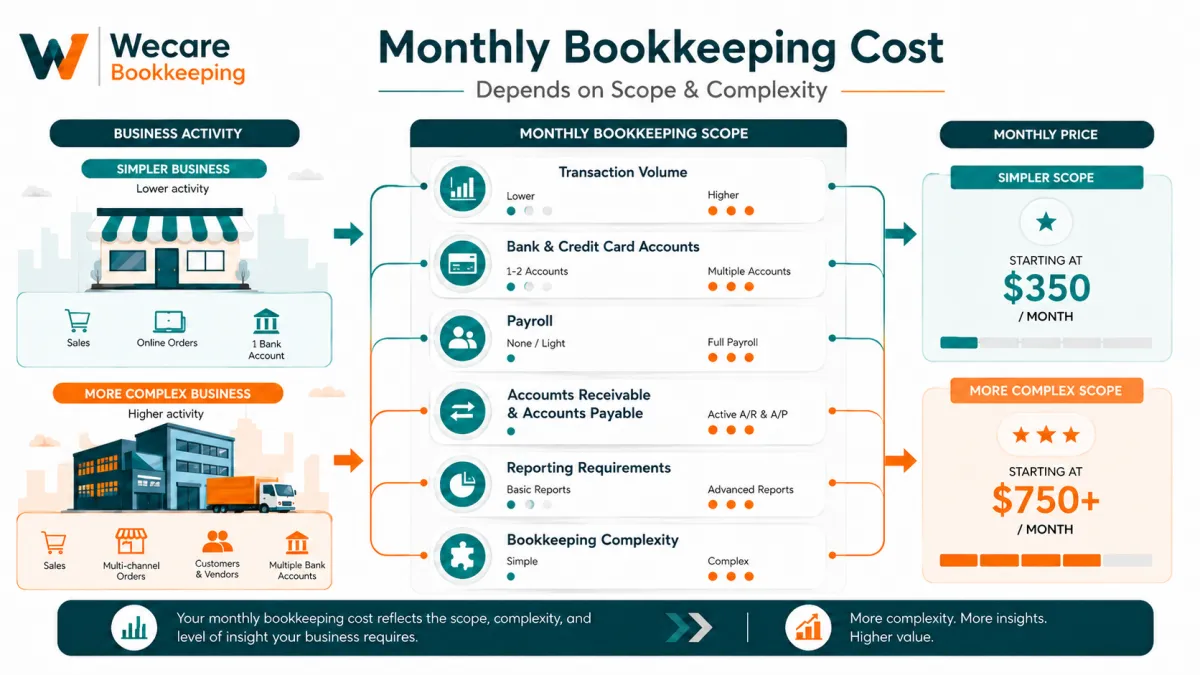
How Much Does Monthly Bookkeeping Cost for a Small Business?
One of the first questions business owners ask when considering professional bookkeeping is simple:
How much will it cost each month?
The difficult part is that monthly bookkeeping is not a single standardized service.
A small consulting business with one bank account, no payroll, and 80 monthly transactions does not require the same workload as an ecommerce company with several sales channels, inventory, payroll, payment processors, and hundreds of transactions.
Both businesses may need monthly bookkeeping, but the scope is different.
That is why responsible bookkeeping pricing should reflect the actual work required rather than relying on one universal price.
The cost of monthly bookkeeping usually depends on transaction volume, number of financial accounts, operational complexity, payroll, accounts receivable and payable, reporting expectations, and the current condition of the books.
Understanding those factors makes it easier to compare proposals and choose a service that fits the business.
How Much Does Monthly Bookkeeping Cost Per Month?
For Wecare Bookkeeping, monthly bookkeeping currently starts at $350 per month for businesses with straightforward bookkeeping needs.
Businesses with more accounts, higher activity, additional reporting requirements, or greater operational complexity generally require a broader scope. Wecare’s Growth plan starts at $750 per month, while businesses with more complex bookkeeping and reporting requirements receive custom pricing after the scope is reviewed.
A simple way to think about the current service levels is:
Essential — Starts at $350/month
Best for businesses with straightforward monthly bookkeeping needs and a clean financial workflow.
Growth — Starts at $750/month
Best for growing businesses with more accounts, more activity, additional reporting needs, or broader operational support.
Scale — Custom pricing
Best for established businesses with greater complexity, higher transaction volume, multiple workflows, or advanced reporting needs.
These are starting prices rather than universal quotes. The final monthly fee depends on the actual bookkeeping scope, including transaction volume, number of accounts, payroll, accounts receivable and payable, payment processors, reporting requirements, and the condition of the existing books.
For current package details, see Wecare Bookkeeping’s Pricing page.
Why Monthly Bookkeeping Prices Vary
Bookkeeping pricing varies because every business produces a different volume and type of financial activity.
A bookkeeper may need to:
Review and categorize transactions
Reconcile bank and credit-card accounts
Record payroll activity
Track loans and financing
Review customer payments
Enter or monitor vendor bills
Reconcile payment processors
Review inventory activity
Investigate unusual balances
Prepare monthly financial reports
Communicate with the owner about unclear transactions
Correct prior-period issues
Maintain industry-specific workflows
A business with a simple, consistent process generally requires less monthly work.
A business with several systems, incomplete documentation, or complex transactions generally requires more.
The monthly price should therefore reflect both the volume of activity and the judgment required to maintain reliable books.
Transaction Volume
Transaction volume is one of the most common pricing factors.
Transactions may include:
Customer payments
Vendor expenses
Bank fees
Credit-card charges
Payroll withdrawals
Loan payments
Transfers
Refunds
Owner contributions
Owner distributions
Payment-processor deposits
Sales-platform activity
A business with 75 monthly transactions generally requires less review than one with 750.
However, volume alone does not determine the full workload.
Seventy-five complex transactions involving multiple properties, loans, or payment processors may require more attention than several hundred routine transactions that follow a consistent pattern.
A useful scope review considers:
Average monthly transaction count
Seasonal fluctuations
Number of uncategorized transactions
Frequency of duplicate or unclear activity
Amount of manual entry required
Quality of supporting documentation
Number of Bank and Credit-Card Accounts
Every bank, credit-card, loan, or payment account creates an additional reconciliation responsibility.
A small business may have:
One operating bank account
Several credit cards
A savings account
A payroll account
A tax set-aside account
Business loans
Merchant accounts
Payment-processor clearing accounts
Each account must be reviewed and reconciled separately.
More accounts can increase the monthly workload because the bookkeeper must:
Confirm all activity was imported or entered
Identify transfers between accounts
Investigate missing transactions
Review outstanding items
Match statement balances
Resolve duplicate entries
Confirm the ending balance
Unused accounts can also create work if they remain connected or appear in the financial statements with unexplained balances.
Payroll Complexity
Payroll affects bookkeeping even when the payroll itself is processed by a separate provider.
Monthly bookkeeping may need to account for:
Gross wages
Employer payroll taxes
Employee deductions
Benefit contributions
Payroll liabilities
Payroll service fees
Reimbursements
Contractor payments
Multiple payroll withdrawals
Department or project allocations
A business with one owner and no employees has a simpler payroll-related workflow than a company with 20 employees, benefits, reimbursements, bonuses, and several payroll categories.
Payroll complexity can also increase when:
Payroll reports do not match bank withdrawals
Employees work across several projects
Payroll liabilities remain unpaid
Historical entries are incomplete
Payroll data is recorded only as net withdrawals
The business uses more than one payroll provider
The bookkeeper’s role and the payroll provider’s role should be clearly defined in the engagement scope.
Accounts Receivable
Accounts receivable refers to amounts customers owe the business.
A monthly bookkeeping service may include different levels of accounts-receivable support.
Basic bookkeeping may include:
Recording invoices already created by the business
Applying customer payments
Reconciling deposits
Reviewing unpaid balances
Producing an aging report
More involved support may include:
Creating invoices
Sending payment reminders
Reviewing customer disputes
Following up on overdue balances
Applying credits
Tracking deposits or retainers
Reconciling merchant payments
The more responsibility the bookkeeper has for customer billing and collections, the broader the monthly scope becomes.
A service proposal should explain whether accounts-receivable work is included, limited, or offered as an add-on.
Accounts Payable
Accounts payable refers to amounts the business owes vendors.
Basic monthly bookkeeping may include recording expenses from bank and credit-card activity.
A more complete accounts-payable workflow may require:
Entering vendor bills
Tracking due dates
Reviewing unpaid balances
Preparing payment schedules
Collecting approval from the owner
Matching payments to bills
Managing vendor credits
Maintaining vendor records
Supporting year-end contractor reporting
A business that pays expenses directly by credit card has a different workflow from one that receives dozens of vendor bills with payment terms.
The bookkeeping price should reflect who is responsible for each part of the process.
Inventory and Cost of Goods Sold
Inventory adds another layer of bookkeeping complexity.
An inventory-based business may need to track:
Product purchases
Freight
Import costs
Vendor credits
Inventory adjustments
Cost of Goods Sold
Damaged or obsolete inventory
Inventory held in several locations
Sales across multiple platforms
QuickBooks may not contain every operational inventory detail, especially when the business uses Shopify, Amazon, a warehouse system, or another inventory platform.
The bookkeeper may need to reconcile summaries between systems rather than simply categorize bank transactions.
Inventory workflows should be clearly documented because inaccurate inventory and Cost of Goods Sold can significantly affect gross-profit reporting.
Ecommerce and Payment Processors
Ecommerce bookkeeping often costs more than simple service-business bookkeeping because one bank deposit may contain many underlying transactions.
A single Shopify, Stripe, Amazon, Etsy, or PayPal payout may include:
Gross sales
Refunds
Discounts
Processor fees
Chargebacks
Shipping income
Sales tax
Withheld reserves
Timing differences
Recording only the net bank deposit can understate revenue and hide important expenses.
A structured ecommerce workflow may require clearing accounts, sales summaries, processor reports, and monthly reconciliation between platforms and QuickBooks.
The number of platforms and payment processors can therefore affect the monthly price.
Projects, Job Costing, and Multiple Properties
Businesses that need profitability reporting by project, customer, location, or property require more detailed transaction assignment.
Examples include:
Contractors
Agencies
Consultants
Real estate investors
Professional-service firms
Event businesses
Field-service companies
The bookkeeper may need to assign:
Revenue
Materials
Labor
Subcontractors
Equipment
Travel
Property expenses
Shared costs
A transaction can be correctly categorized at the company level and still be missing the project or property assignment needed for detailed reporting.
Project-level bookkeeping often requires additional review to ensure every direct cost is connected to the correct job.
Multiple Entities
A business owner may operate several legal entities or business activities.
Each entity may need:
Separate bank accounts
Separate bookkeeping files
Separate reconciliations
Separate financial reports
Intercompany transaction tracking
Due-to and due-from balances
Separate documentation
Separate monthly reviews
Combining activity from different entities can create reporting and compliance problems.
When each entity requires its own books, monthly pricing is generally determined separately or through a clearly defined multi-entity package.
Legal and tax questions about entity structure should be reviewed with the appropriate professionals.
Condition of the Existing Books
A business may request monthly bookkeeping while the existing file contains unresolved historical problems.
Examples include:
Bank accounts that have never been reconciled
Duplicate transactions
Incorrect opening balances
Old uncleared checks
Negative asset or liability balances
Uncategorized activity
Personal expenses mixed with business activity
Inaccurate loan balances
Duplicate income
Missing payroll entries
Unreliable accounts receivable or payable
Monthly bookkeeping and historical cleanup are different scopes of work.
A bookkeeper may first need to complete:
Catch-up bookkeeping
QuickBooks cleanup
Opening-balance corrections
Historical reconciliations
Chart-of-accounts restructuring
Payment-processor reconciliation
That initial work may be priced separately from the ongoing monthly service.
For a detailed comparison, read QuickBooks Cleanup vs. Catch-Up Bookkeeping: What Is the Difference?
Reporting Requirements
Most monthly bookkeeping services provide standard financial reports.
These may include:
Profit and Loss
Balance Sheet
Cash Flow Statement
Accounts Receivable Aging
Accounts Payable Aging
General Ledger
Transaction Detail
Reports by class, project, location, or property
A basic monthly package may include standard reports with limited commentary.
A more advanced engagement may include:
Customized reporting
Department comparisons
Budget-versus-actual analysis
Property-level reporting
Project profitability
Cash-flow review
Monthly performance commentary
Management meetings
KPI tracking
Customized reports and recurring review meetings require more preparation and professional time.
The proposal should explain what reports are included and whether interpretation or advisory support is part of the service.
Communication and Responsiveness
Communication expectations also affect scope.
Some businesses need:
One monthly email
A short list of questions
Quarterly review meetings
Others expect:
Weekly communication
Same-day answers
Multiple internal contacts
Vendor and customer coordination
Ongoing accounting-system support
Frequent reporting changes
A high-touch engagement usually requires more time than a low-touch monthly close.
The service agreement should define:
Primary contact
Communication channel
Expected response times
Meeting frequency
Document-request process
Approval responsibilities
Escalation process
Clear expectations protect both the client and the bookkeeper.
Monthly Bookkeeping Versus Cleanup Work
Ongoing monthly bookkeeping maintains current records.
Cleanup work corrects existing problems.
A monthly service may include:
Current transaction review
Current reconciliations
Current payroll entries
Current reporting
Routine monthly questions
Cleanup may include:
Correcting prior periods
Rebuilding reconciliations
Removing duplicate transactions
Fixing account mappings
Correcting loan balances
Resolving historical accounts receivable
Investigating unsupported balances
A low monthly quote may not include the cleanup required to make the file reliable.
Before comparing prices, confirm whether the proposal covers:
Only future months
The current month
Historical catch-up
Historical cleanup
System restructuring
Opening-balance corrections
What Should Monthly Bookkeeping Include?
A well-defined monthly service should explain its recurring deliverables.
Depending on the business, monthly bookkeeping may include:
Transaction review and categorization
Bank-account reconciliation
Credit-card reconciliation
Loan and liability review
Payroll entry review
Accounts receivable review
Accounts payable review
Payment-processor reconciliation
Review of uncategorized transactions
Review of unusual balances
Month-end adjustments
Standard financial reports
A monthly close confirmation
Client questions and follow-up
At Wecare Bookkeeping, the level of monthly support increases with the scope. Essential focuses on core monthly bookkeeping and financial reporting; Growth adds broader reporting and operational support; Scale is designed for more complex workflows, reporting, and multi-entity or higher-volume requirements.
The exact scope should be written into the proposal or engagement letter.
For a broader overview, read What Monthly Bookkeeping Should Include for a Growing Business.
Fixed Pricing Versus Hourly Pricing
Bookkeeping services may be priced hourly, monthly, or by project.
Hourly pricing
Hourly pricing charges for actual time spent.
It may be appropriate when:
The scope is uncertain
The books require investigation
The work is temporary
The business needs occasional support
The disadvantage is that the monthly total may vary.
Fixed monthly pricing
Fixed monthly pricing provides a recurring fee based on an agreed scope.
It may be appropriate when:
The monthly workflow is predictable
Responsibilities are clearly defined
Transaction volume is relatively stable
Both parties understand the deliverables
The fee may need to change when the business grows or the scope expands.
Wecare Bookkeeping uses scope-based monthly pricing for ongoing bookkeeping services. Current monthly plans start at $350 for Essential and $750 for Growth, with custom pricing for businesses requiring a more complex Scale-level scope.
Project pricing
Project pricing is often used for:
Cleanup
Catch-up bookkeeping
QuickBooks setup
Historical reconciliation
System migration
Process redesign
The project fee should reflect the condition of the books and the work required.
No pricing model eliminates the need for clear scope.
Warning Signs of an Unrealistically Low Quote
A lower price is not automatically a problem.
However, a quote may deserve closer review when it does not account for the business’s complexity.
Potential warning signs include:
No review of the QuickBooks file
No questions about transaction volume
No questions about bank or credit-card accounts
No discussion of payroll
No review of payment processors
No explanation of reports
No distinction between cleanup and monthly work
No written scope
No explanation of client responsibilities
No process for resolving unclear transactions
No mention of reconciliation
A bookkeeping service can be inexpensive because the scope is narrow and efficient.
It can also be inexpensive because important work is excluded.
The owner should understand the difference.
Questions to Ask Before Comparing Proposals
Before selecting a bookkeeping service, ask:
Which accounts will be reconciled each month?
How many transactions are included?
Is payroll bookkeeping included?
Are accounts receivable and accounts payable included?
Are payment processors reconciled?
Is inventory support included?
Are project, property, or class assignments included?
Which financial reports will I receive?
Will prior-period cleanup be priced separately?
How often will we communicate?
Who is responsible for providing documentation?
What happens when the business grows?
Are software fees included?
Are year-end accountant requests included?
What work is specifically excluded?
Two proposals with different scopes cannot be compared using price alone.
How Wecare Determines Monthly Bookkeeping Scope
Wecare Bookkeeping begins by understanding the business’s actual bookkeeping workflow.
The review may consider:
Industry
Transaction volume
Number of financial accounts
Payroll
Accounts receivable
Accounts payable
Loans
Payment processors
Inventory
Projects or properties
Current QuickBooks condition
Reporting needs
Communication expectations
Historical cleanup requirements
The goal is to define a scope that is practical, supportable, and aligned with the business’s needs.
A simpler business should not be charged for complexity it does not have.
A complex business should not receive a narrow service that leaves important accounts unreconciled or reports incomplete.
Price Should Follow Scope
The most useful question is not only:
How much does monthly bookkeeping cost?
It is:
What work is required to keep this business’s books accurate, reconciled, and useful every month?
A reliable bookkeeping relationship should provide clarity about:
What is included
What is excluded
What the client must provide
When the monthly close will be completed
Which reports will be delivered
How scope changes will be handled
The lowest price is not always the best value.
The highest price does not automatically mean the service is more complete.
The right choice is a clearly defined service that matches the business’s activity, complexity, and reporting needs.
Wecare Bookkeeping helps growing businesses maintain clean, accurate, and decision-ready financial records through structured monthly bookkeeping and QuickBooks support. Monthly bookkeeping with Wecare Bookkeeping starts at $350 per month, with broader Growth services starting at $750 per month and custom pricing available for more complex businesses.
Learn more about my Monthly Bookkeeping Services, Pricing, and QuickBooks Services, or schedule a free consultation to discuss your bookkeeping scope.
Frequently Asked Questions
How much does monthly bookkeeping cost?
Wecare Bookkeeping’s monthly bookkeeping plans currently start at $350 per month for Essential and $750 per month for Growth. Businesses with greater complexity, higher transaction volume, multiple workflows, or advanced reporting needs receive custom Scale pricing. The final fee depends on the actual scope, including transaction volume, number of accounts, payroll, accounts receivable and payable, payment processors, reporting requirements, and the condition of the existing books.
What does a bookkeeper cost per month for a small business?
For Wecare Bookkeeping, ongoing monthly bookkeeping currently starts at $350 per month. Businesses requiring more accounts, reporting, transaction processing, or operational support may fall into the Growth plan starting at $750 per month or require custom pricing. The appropriate monthly fee depends on the actual bookkeeping workload and complexity.
Is monthly bookkeeping priced by transaction count?
Transaction count is often one pricing factor, but it is not the only one. A smaller number of complex transactions may require more work than a larger number of simple, recurring transactions.
Does monthly bookkeeping include QuickBooks cleanup?
Not always. Historical cleanup and ongoing monthly bookkeeping are usually separate scopes. The proposal should state whether prior-period corrections are included.
Does bookkeeping cost more when a business has payroll?
It can. Payroll creates additional entries, liabilities, reconciliations, and reporting responsibilities. The price depends on the payroll workflow and the bookkeeper’s role.
Are bank reconciliations included in monthly bookkeeping?
They should be clearly addressed in the scope. Reconciliation is a core part of reliable monthly bookkeeping, but the proposal should identify which accounts are included.
Is accounts receivable included?
Some services include only recording payments and reviewing balances. Others include invoicing, reminders, and collection support. The level of service should be defined in writing.
Is accounts payable included?
Basic expense recording may be included, while bill entry, approval workflows, and payment scheduling may be separate services.
Why is cleanup priced separately?
Cleanup involves investigating and correcting historical problems. That work is different from maintaining current monthly records and may require significant additional time.
Can the monthly price change?
Yes. The fee may be reviewed when transaction volume, number of accounts, payroll, entities, locations, reporting needs, or other responsibilities change.
Should I choose the least expensive bookkeeping service?
Price should be evaluated together with scope, reconciliation process, reporting, communication, experience, and accountability. A lower fee may reflect a narrower service.